Closing the Gap: What Women in Wastewater Face on the Path to Advancement — and What Utilities Must Do Differently
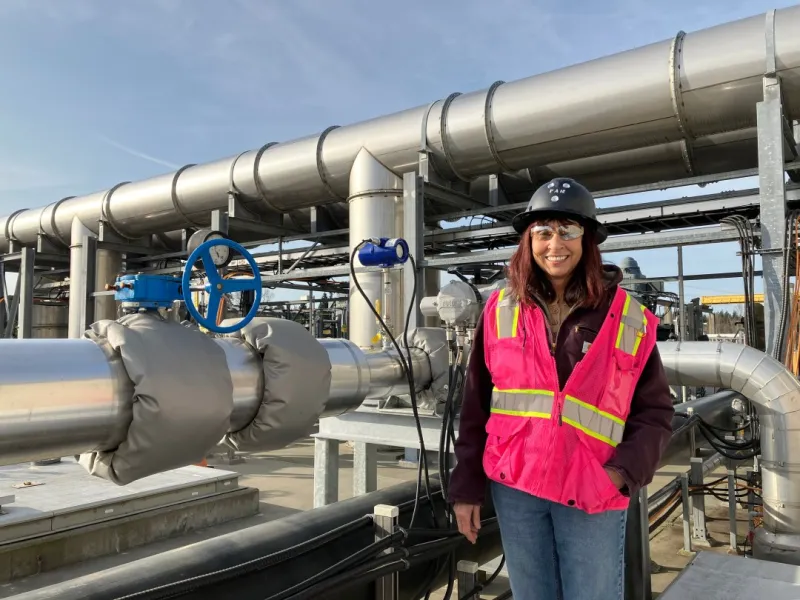
Photo: woman wastewater treatment plant operator working environmental professional, via i0.wp.com
The wastewater industry is facing a workforce crisis that is well documented: an aging operator population, a shrinking pipeline of certified replacements, and infrastructure demands that are accelerating faster than hiring capacity. What is less frequently discussed is the degree to which that crisis is being deepened by the industry's persistent failure to retain and advance the women already working within it.
Women represent a growing share of wastewater and water utility employees, particularly in laboratory, administrative, and environmental compliance functions. But their representation at the licensed operator and supervisory levels remains disproportionately low — and the distance between entry-level presence and senior-level advancement reflects a set of structural and cultural barriers that are neither accidental nor inevitable.
The Credibility Problem in the Field
Among the most consistently reported challenges for women in wastewater operations is what might be called the credibility tax: the additional burden of proving competence in field and plant environments where assumptions about physical capability and technical aptitude still run along gender lines.
This is not an abstraction. Women working in treatment plant operations describe situations in which their process decisions are second-guessed by colleagues who accept identical recommendations from male counterparts without question. They describe contractors who route technical questions to male colleagues regardless of who holds the relevant expertise. They describe training environments in which instruction is delivered differently — less rigorously, or with less assumption of prior knowledge — based on gender.
These experiences accumulate. Over time, they contribute to a pattern in which women who are equally or better qualified than their peers are less likely to pursue leadership opportunities within the same organization — not because they lack ambition, but because the cost of advancing through an environment that consistently questions their standing is higher than the reward.
Utilities that dismiss this as individual sensitivity rather than organizational pattern are misreading their own retention data.
The Mentorship Desert
Mentorship is one of the most reliable accelerants of career advancement in any technical field. In wastewater, where informal knowledge transfer has historically been the primary mechanism for operator development, access to experienced mentors is not merely helpful — it is often the difference between career stagnation and upward mobility.
For women in this industry, that access is structurally uneven. When the overwhelming majority of senior operators, plant managers, and utility directors are men, the informal mentorship networks that develop naturally tend to replicate themselves along gender lines. Women entering the field may find themselves technically employed but professionally isolated — present in the organization but excluded from the conversations, site visits, and relationship-building that define career trajectory.
The absence of visible female role models compounds this problem. When a new operator cannot identify a single woman in a leadership position within their utility or region, the implicit message is that advancement for women in this environment is exceptional rather than expected. That perception shapes behavior in ways that are difficult to reverse without deliberate intervention.
Wage Gaps That Compound Over Time
National wage data for the water and wastewater sector consistently shows compensation gaps between male and female employees that are not fully explained by differences in tenure, certification level, or job function. These gaps tend to be most pronounced at the supervisory and management levels — precisely where pay decisions are made with the greatest degree of discretion and the least external accountability.
What makes compensation gaps in this industry particularly consequential is their compounding effect. A woman who enters a utility at a slightly lower starting salary than a comparable male counterpart — a gap that may feel modest at the time — will, over a 30-year career, accumulate a substantially different retirement position, a different capacity for professional development investment, and a different baseline from which future salary negotiations are conducted. The gap is not static; it grows.
Utilities that conduct regular, transparent pay equity analyses — and that are willing to act on what those analyses reveal — are not just doing the right thing. They are building organizations in which talented women have a financial reason to stay.
What Utilities With Intentional Advancement Programs Are Doing Differently
Across the U.S., a growing number of water and wastewater utilities have moved beyond awareness programming to implement structural changes that measurably improve outcomes for women in their organizations. Their approaches share several common elements.
Formalized sponsorship, not just mentorship. Mentorship provides guidance; sponsorship provides opportunity. Utilities that are seeing results have distinguished between the two and created programs in which senior leaders actively advocate for high-potential women in promotion discussions, project assignments, and professional development opportunities — not merely offering advice when asked.
Structured pay equity reviews. Rather than addressing compensation gaps reactively — when an employee raises a concern or prepares to leave — leading utilities conduct proactive, systematic compensation analyses on a defined schedule. These reviews examine pay across gender, tenure, and certification level, and they carry organizational commitment to correction when disparities are identified.
Visible leadership pipelines. Utilities that intentionally place women in high-visibility roles — leading regulatory inspections, representing the organization at industry conferences, managing capital projects — are creating the visible pathways that counteract the implicit message that advancement is reserved for others. These are not symbolic gestures; they are career-defining opportunities that shape how an individual is perceived internally and externally.
Field culture accountability. Several utilities have implemented peer accountability frameworks in which field team culture — including how new employees are welcomed, how technical authority is distributed, and how concerns about workplace conduct are handled — is treated as a management responsibility rather than an interpersonal matter. The difference between organizations that do this and those that do not is measurable in retention rates.
The Business Case That Cannot Be Ignored
For utility managers who view equity initiatives primarily through a compliance or reputational lens, the workforce math makes the case more bluntly than any values statement can.
The U.S. wastewater sector is projected to face a shortage of tens of thousands of qualified operators over the next decade. Recruiting from a labor pool that excludes or alienates half the potential workforce is not a viable long-term strategy. Utilities that create environments where women are recruited effectively, developed deliberately, and retained through advancement are not just building more equitable organizations — they are building organizations that will survive the staffing crisis that is already arriving.
The women currently working in wastewater — in laboratories, at control panels, in compliance offices, and in the field — represent a reservoir of expertise and institutional knowledge that the industry cannot afford to waste. The utilities that recognize this, and act accordingly, will be the ones with the workforce to meet what comes next.